
Table of Contents
Introduction to Milling Machines
Milling Machines are one of the most important machines used in the modern world of manufacturing or machining industries. These machines are specifically designed to cut or shape the material from the workpiece with high precision. Milling Machines are used in every workshop or industry to manufacture various metal components or machine parts.
Milling Machines are widely used due to their ability to perform various operations like cutting slots, drilling holes, or making surfaces. With the advent of technology, modern Milling Machines are becoming more precise or easy to operate, making them an important part of various industries like the automobile industry or the aerospace industry.
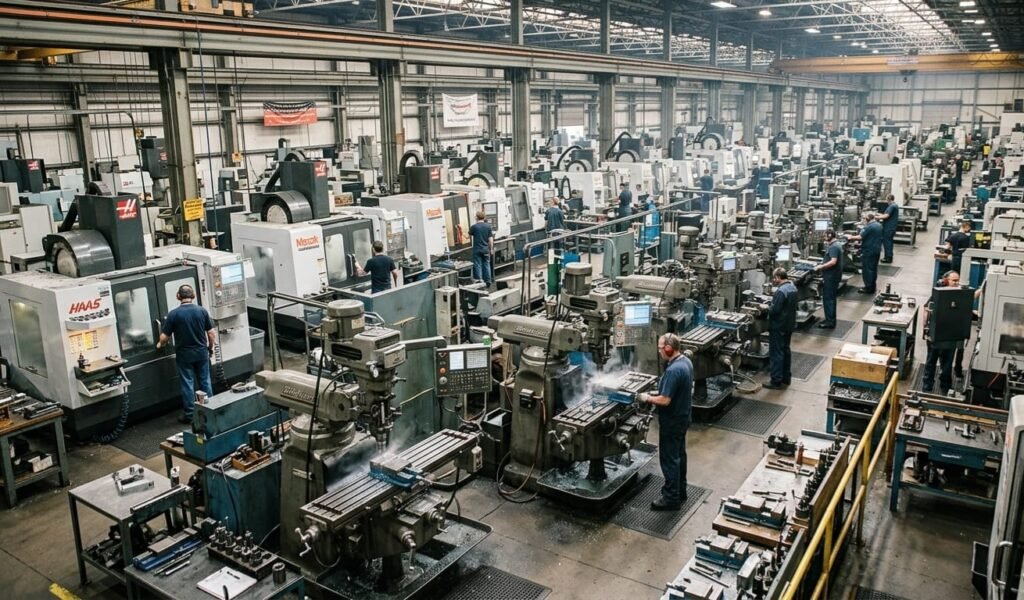
A Milling Machine is a machine tool that removes material from a workpiece by means of a rotating cutting tool referred to as a Milling Cutter. The tool revolves at a high speed while the workpiece moves in different directions to achieve the desired shape.
Unlike other machine tools for cutting, Milling Machines can be used to cut flat or complex shapes with a high level of precision. Generally, the machine tool consists of a rotating spindle that holds the cutting tool while the workpiece is held by a movable table. With the ability to change the position of the workpiece relative to the cutting tool, various machining operations can be carried out.
Due to the flexibility of the machine tool, Milling Machines are commonly used for metalwork, tool making, and mechanical engineering.
How Does a Milling Machine Work?
The working principle of Milling Machines depends on the rotational motion of a cutting tool to cut the material from a stationary or moving part. The cutting tool revolves at a high speed, and as soon as the tool comes into contact with the material to be cut, small chips of the material are cut from the surface.
In most cases, the workpiece is fixed to the table of the Milling Machine. The table moves in different directions, forward, backward, or sideways. With the help of the table’s motion, Milling Machines can be used to create different shapes or patterns on the material.
In modern industries, CNC Milling Machines are used to cut the material with high precision by automatically operating the machine.
Main Parts of a Milling Machine
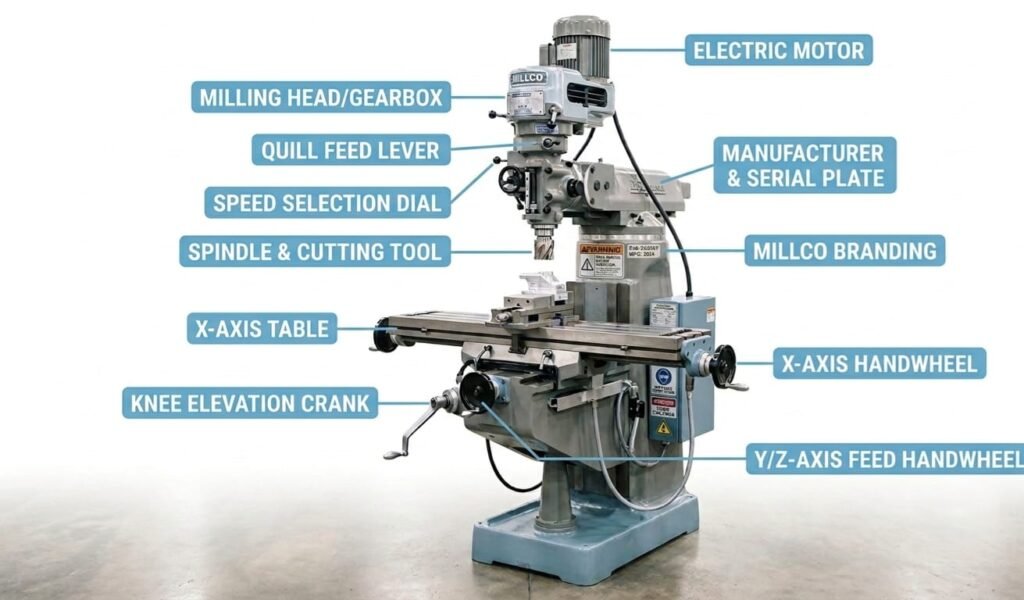
Knowledge of the main components of Milling Machines is useful in ensuring their proper usage and maintenance. Some of these components are as follows:
Base:
This is the bottom portion of the Milling Machine.
Column:
This is a vertical structure in a Milling Machine where various components are mounted.
Knee:
This is a component of a Milling Machine where the saddle and table are mounted. It moves up and down.
Saddle:
This component is mounted on the knee and supports the table, enabling it to move horizontally.
Table:
This component supports the workpiece during milling operations and moves in different directions.
Spindle:
This component rotates during milling operations to perform the milling function.
From the above description of the main components of Milling Machines, it is clear that these machines are capable of performing their functions through these components.
Types of Milling Machines
There are different types of Milling Machines, each with different uses in machining operations.
Vertical Milling Machine
In the case of the Vertical Milling Machine, the spindle is mounted vertically. In general, the Vertical Milling Machines are used for face milling, slot cutting, and drilling operations.
Horizontal Milling Machine
In the case of the Horizontal Milling Machine, the spindle is mounted horizontally. In general, the Horizontal Milling Machines are used for heavy machining operations.
Universal Milling Machine
This type of milling machine is capable of carrying out both horizontal and vertical milling operations.
CNC Milling Machine
CNC stands for Computer Numerical Control. In the case of the CNC Milling Machine, the machining operations are carried out using computer programming.
Common Milling Machine Operations
Milling Machines are capable of performing a variety of different operations. Some of the most common milling operations are as follows:
1.Face Milling
Face milling is done to create flat surfaces on the workpiece.
2.Plain Milling
Plain milling is done to create flat horizontal surfaces.
3.Slot Milling
Slot milling is done to create slots in the workpiece.
4.End Milling
End milling is done using a special tool to create slots, pockets, and contours.
5.Angular Milling
Angular milling is done to create angular surfaces on the workpiece.
This variety of milling operations makes Milling Machines a highly versatile machine tool in a machining workshop.
Advantages of Milling Machines
There are a number of reasons why Milling Machines are employed in the manufacturing industry.
High Precision
It is capable of creating highly accurate and detailed components.
Versatility
Milling Machines are capable of performing a variety of functions using different cutting tools.
Efficiency
It makes it possible to carry out faster cutting operations compared to doing it manually.
Ability to Create Complex Shapes
Modern Milling Machines, especially CNC Milling Machines, are capable of creating complex components.
For these reasons, Milling Machines are a vital component in any manufacturing industry where precision is a requirement.
- What are Milling Machines used for?
Milling Machines are used to cut, shape, and remove material from metal and other materials to make machine parts and components.
- What materials can Milling Machines cut?
They are able to cut through steel, aluminum, brass, plastics, and sometimes wood.
- What is the difference between a milling machine and a lathe machine?
In the Milling Machine, the cutting tool rotates, whereas the workpiece moves. However, the workpiece rotates, and the cutting tool remains stationary in the lathe machine.
- Are CNC Milling Machines better than manual machines?
CNC Milling Machines are more precise and accurate compared to manual machines.