
Table of Contents
Introduction to Dial Gauges
Precision measuring tools called dial gauges are frequently used in manufacturing, maintenance, and mechanical engineering. They are made to accurately measure variations, deviations, and small linear distances. Dial gauges are essential for maintaining quality and accuracy in industrial applications, whether you are checking alignment, flatness, or runout.
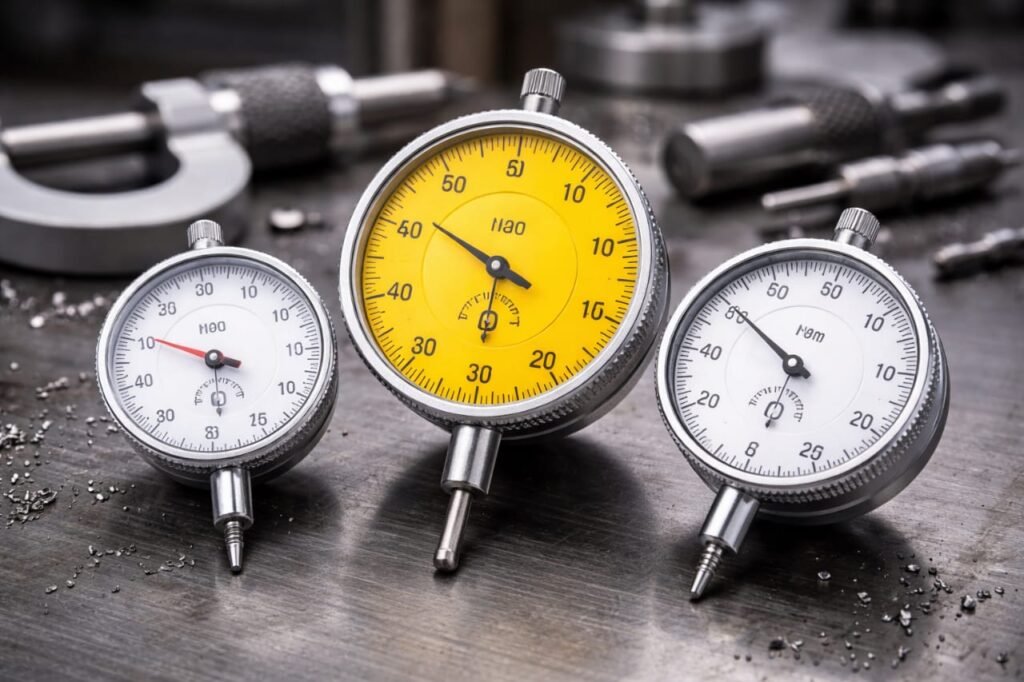
Dial Gauges, also called dial indicators, are generally used to measure the displacement or movement of a part of a component. Dial Gauges are made of a circular dial with a needle that changes its position as the plunger comes into contact with a surface.
Dial Gauges are very simple to use, but at the same time, they are very effective in measuring the changes, no matter how small, in the dimensions of a part of a component. Dial Gauges are a must-have tool in the workshops, power plants, and inspection departments of plants.
Types & Variations
There are a number of Dial Gauges available depending on the application:
Plunger Type Dial Gauges – Most commonly used, wherein the probe is moved in and out linearly.
Lever Type Dial Gauges – Also called dial test indicators, which are used for tight measurement.
Digital Dial Gauges – Used to show the results on a digital screen.
Back Plunger Dial Gauges – Used for applications wherein space is a problem.
Each of the Dial Gauges has its own specific uses, making the Dial Gauges versatile instruments.
Parts & Construction
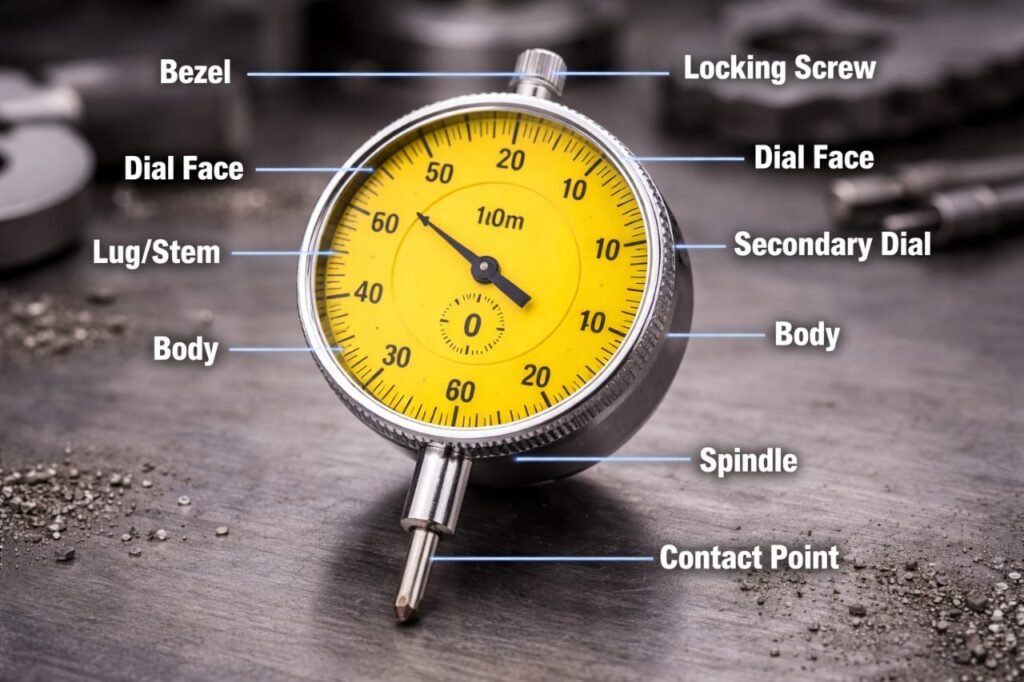
Dial Gauges consist of several vital components:
Dial Face – Shows the measurement readings on the dial face.
Pointer/Needle – Points to show the measured value.
Plunger/Probe – Comes into contact with the workpiece to be measured.
Bezel – Used to set zero reference on the dial face.
Stem – Used for fixing the Dial Gauges.
Internal Gear Mechanism – Used to convert linear movement to rotational movement of the pointer.
The construction of Dial Gauges is rugged and precise to ensure accurate readings for longer periods.
Working & Usage
The working principle of the Dial Gauges is the mechanical movement principle. When the plunger comes in contact with the surface, it moves either up or down. This movement is transmitted through the gear inside the device, and the needle on the dial rotates to show the measurement.
- Mount the gauge firmly on a stand.
- Zero the dial gauge.
- Bring the probe in contact with the object.
- Observe the movement of the needle to measure the deviation.
Dial Gauges are generally used for checking the alignment, runout, flatness, and concentricity of parts
Accuracy & Calibration
Accuracy is one of the most significant aspects of Dial Gauges. A small mistake may affect the entire measuring procedure.
To ensure accuracy, the following steps should be taken:
Always use standard gauge blocks for the calibration of the Dial Gauges.
Avoid any kind of shock or drop.
Use the correct range for the measurement.
Maintenance & Care
Maintenance of Dial Gauges helps to prolong the life of the gauges while ensuring proper functionality.
Here are some simple tips for maintaining Dial Gauges:
Ensure that the Dial Gauges are clean and free from any form of dust or oil.
Ensure that the Dial Gauges are stored in protective cases.
Ensure that the Dial Gauges are not exposed to moisture or extreme temperatures.
Ensure that the moving parts of the Dial Gauges are lubricated.
By maintaining the Dial Gauges, we can prolong the life of the gauges while ensuring proper functionality.
Troubleshooting & Tips
In certain cases, the readings of the Dial Gauges might not be accurate due to minor problems. The common issues and their solutions are as follows:
Needle not moving smoothly → Check if there is any dirt or internal damage.
Incorrect readings → Recalibrate the gauge.
Loose mounting → Properly fix the gauge on the stand.
Zero error → Reset the bezel.
In this way, time can be saved and the accuracy of the measurements can be maintained during critical operations.
Customer FAQ
Q1: What is the use of Dial Gauges?
Dial Gauges are used to measure small displacements, alignment, runouts, and dimensional changes.
Q2: How accurate is Dial Gauge?
Dial Gauges can measure accurately up to 0.01 mm or even better depending on the model of Dial Gauge.
Q3: What is the difference between dial gauge and digital gauge?
Dial Gauges indicate measurements by a mechanical needle pointer, whereas digital gauges indicate measurements electronically.
Q4: How often is it necessary to calibrate Dial Gauges?
Dial Gauges need to be calibrated as often as required.
Q5: Can Dial Gauges be used by beginners?
Dial Gauges can be used by beginners as they are easy to use.
Conclusion
Dial Gauges are one of the most important instruments used in engineering and industrial fields. Their accuracy and simplicity make them essential in quality control and maintenance activities. Knowing the types of Dial Gauges and how to work and maintain them will help you make the best out of using Dial Gauges in your day-to-day activities.