
Introduction to Shaping Machine
A shaping machine is considered to be one of the most commonly utilized machine tools in mechanical engineering and various manufacturing industries. A shaping machine is generally utilized to create flat surfaces, slots, grooves, and keyways on metal pieces. The basic concept of a shaping machine is to move a cutting tool back and forth on a workpiece to eliminate excess material.
Though various machining processes like milling and CNC are being utilized in today’s world, a shaping machine is still significant in various mechanical engineering works and repair operations. A shaping machine is considered to be a simple and affordable tool that is useful in small mechanical engineering works and tool rooms. Knowing about a shaping machine and its operation is helpful in learning basic concepts about metal cutting and machining.
Table of Contents
A shaping machine is a type of machine tool that is utilized to shape a metal or any material into a required shape with the help of a single-point cutting tool. In this machine tool, the cutting tool is moved in a linear fashion over a workpiece to perform a cutting action.
The main function of a shaping machine is to produce flat surfaces with high accuracy. Moreover, it is also utilized to perform operations such as cutting grooves, slots, and keyways. During a forward motion of a tool, a cutting action is performed, whereas a return motion does not perform a cutting action.
Because of its ability to produce smooth and accurate surfaces, a shaping machine is utilized in various mechanical departments and manufacturing units.
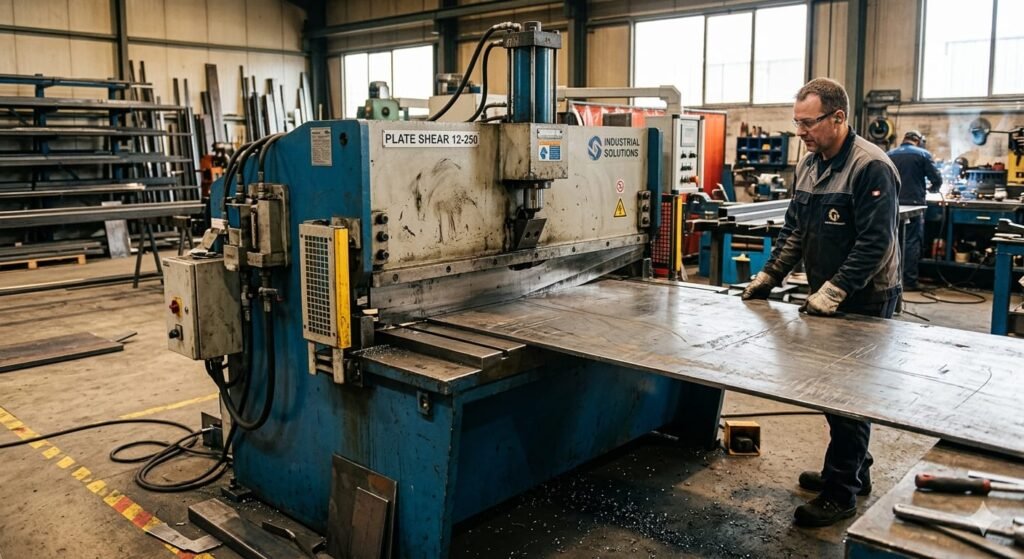
Shaping Machine: The shaping machine has been used for many decades in the machining field. The shaping machine was invented during the early industrial revolution, and there was a need for machines that could be used for shaping metals.
In the 19th century, the shaping machine was invented by engineers for simple cutting operations on metals. These early machines were operated manually and had the ability to use mechanical movements for the cutting tool. Later, the design and technology were improved, and the shaping machine became more efficient.
Later, hydraulic technology was also added to the shaping machine, and this helped improve the smooth movement of the cutting tool. Though many other machines are used today for operations, the shaping machine is still used for educational and small-scale operations.
Working Principle of a Shaping Machine
The machine used in shaping is called a shaping machine. The working principle of a shaping machine is based on reciprocating motion.
In shaping, a cutting tool is moved back and forth over a workpiece to remove metal.
The cutting tool moves over the surface of the workpiece in a reciprocating motion and removes a thin metal layer from the surface of the workpiece in one direction. The cutting tool returns to its original position without cutting in the other direction.
The workpiece is firmly fixed to the shaping machine’s table, and the cutting tool is fixed to the tool head.
The tool and table are moved to produce a variety of shapes and surfaces.
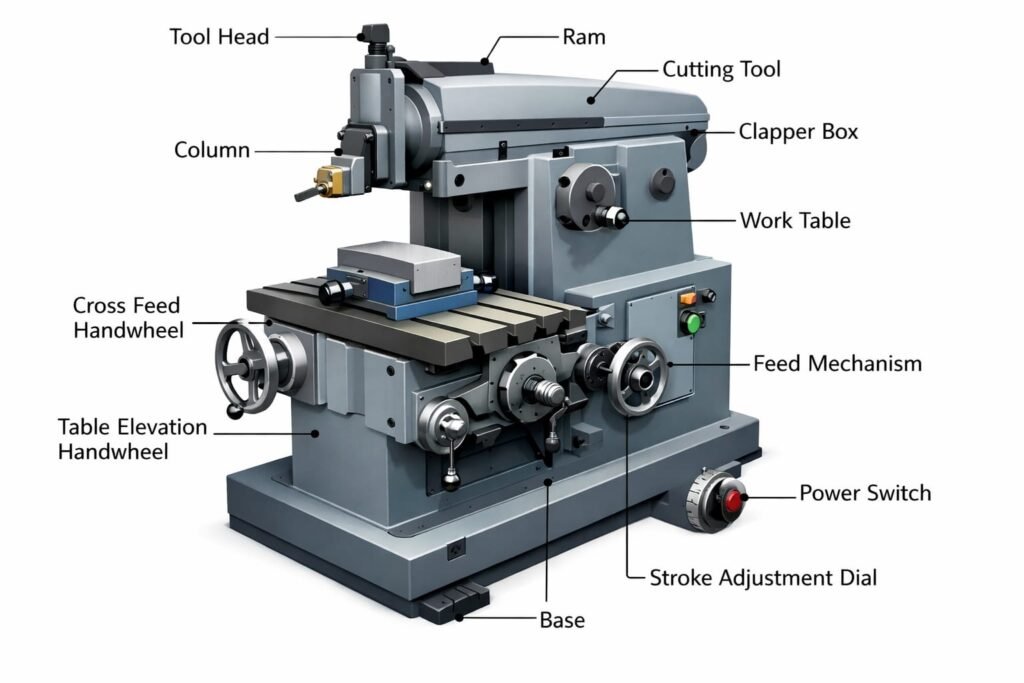
Main Parts of a Shaping Machine
A shaping machine is composed of various vital parts that work together to facilitate a machining operation.
- Base
The base is the lowest part of a shaping machine. It acts as a supporting component to give stability to the whole machine.
- Column
The column is a vertical component of a shaping machine that is fixed to the base. It carries a driving mechanism that drives a ram.
- Ram
A ram is a moving component of a shaping machine that carries a cutting tool. It reciprocates during a shaping operation.
- Tool Head
A tool head is a component of a shaping machine that carries a cutting tool and is used to adjust the tool to a required cutting depth and angle.
- Table
A table is a component of a shaping machine where a workpiece is fixed. It is adjustable in both vertical and horizontal directions to facilitate a workpiece’s positioning.
- Clapper Box
A clapper box is a component of a shaping machine that carries a tool holder and is used to allow a tool to rise a little during a return stroke to prevent damage to a cutting edge.
Types of Shaping Machines
The various types of shaping machines are designed for specific machining operations.
- Crank Type Shaper
This type of shaping machine is the most commonly used. This shaping machine uses the crank type to produce the reciprocating motion of the ram.
- Geared Type Shaper
This shaping machine uses gears to produce the motion of the ram. This shaping machine produces smoother motion compared to the crank type shaper.
- Hydraulic Shaper
A shaping machine with the use of the hydraulic system produces the motion of the ram. This shaping machine produces smoother motion and control over the cutting speed.
- Vertical Shaper (Slotter)
A shaping machine with the vertical motion of the ram is called the slotter. This shaping machine is used for cutting internal slots and keyways.
Shaping Machine Operations
A shaping machine is capable of carrying out various machining operations depending on the position of the tool and workpiece.
- Horizontal Cutting
This operation is used to create flat horizontal surfaces on the workpiece.
- Vertical Cutting
Vertical surfaces can be created using a shaping machine by adjusting the tool head of the shaping machine.
- Angular Cutting
A shaping machine is capable of creating angular surfaces by placing the tool at a particular angle.
- Slot Cutting
Slots can be cut on the workpiece using the cutting tool of the shaping machine.
- Keyway Cutting
A shaping machine is commonly used for keyway cutting.
Customer FAQs About Shaping Machine
- What is the use of a shaping machine?
The shaping machine is employed to create flat surfaces, grooves, slots, and keyways on metal pieces.
- What kind of cutting tool is employed on a shaping machine?
A single-point cutting tool is generally employed on a shaping machine.
- Is shaping machine still employed today?
Yes, shaping machines are still employed today in workshops, tool rooms, and training centers.
- What kind of materials can be machined on a shaping machine?
Materials that can be machined on a shaping machine are steel, aluminum, brass, and cast iron.