
Introduction to Digital Micrometers
In modern engineering and manufacturing, the process of accurate (measurement Digital Micrometers) is very important. If any error occurs in the process of measurement, it may affect the quality of the product. That is why precision measurement tools are used in workshops and industries. One of the most reliable tools used for precise measurements, especially for very small measurements, is the digital micrometer.
Digital micrometers are sophisticated instruments used to measure the thickness, diameter, and length of objects with high precision. Unlike conventional micrometers, in the case of micrometers, the measured values are displayed on an electronic screen, making it easier to use and minimizing the chances of human error in the process of measurement.
In modern times, micrometers are being used in mechanical workshops, manufacturing industries, and engineering projects due to their accuracy, convenience, and easy reading ability.
Table of Contents
What Is a Digital Micrometer?
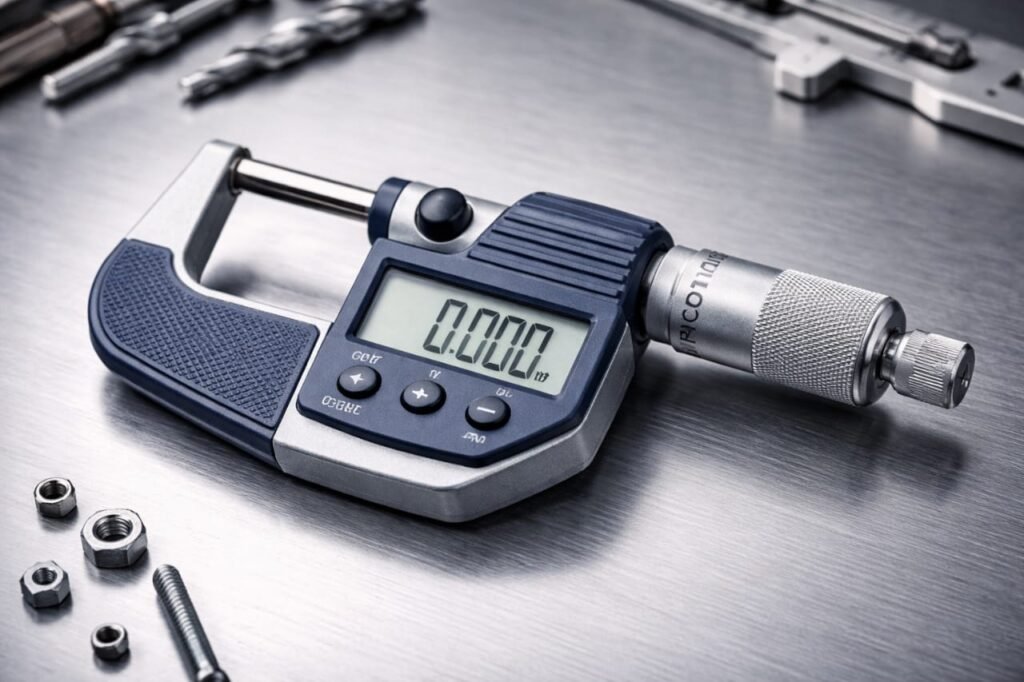
A digital micrometer is a precise measuring tool used for measuring extremely small measurements such as thickness, external diameters, or spaces between two objects. A digital micrometer is a more advanced version of a micrometer screw gauge.
The main purpose of a micrometer is to offer precise measurements up to 0.001mm or even more precise measurements depending on the model used. Since a digital micrometer shows measurements on a screen, users don’t need to make sense of measurements as in a mechanical micrometer.
Another advantage associated with a micrometer is that it can be set to different units such as millimeters or inches. As a result, a digital micrometer can be extremely beneficial for engineers or technicians who deal with international units of measurement.
How a Digital Micrometer Works
The principle on which digital micrometers function is similar to that used in normal micrometers. As the thimble is turned, the spindle will move either towards or away from the anvil. The object to be measured will be placed in these two sections.
As the spindle makes contact with the object, the movement is detected by a sensor within the micrometer. The sensor converts this movement into a digital format, which is then processed by internal circuitry within the micrometer and displayed on a screen as a measurement.
Since the measurement is automatically performed by a digital micrometer, users can easily read the results displayed on the screen without making errors as might be experienced when using a normal scale.
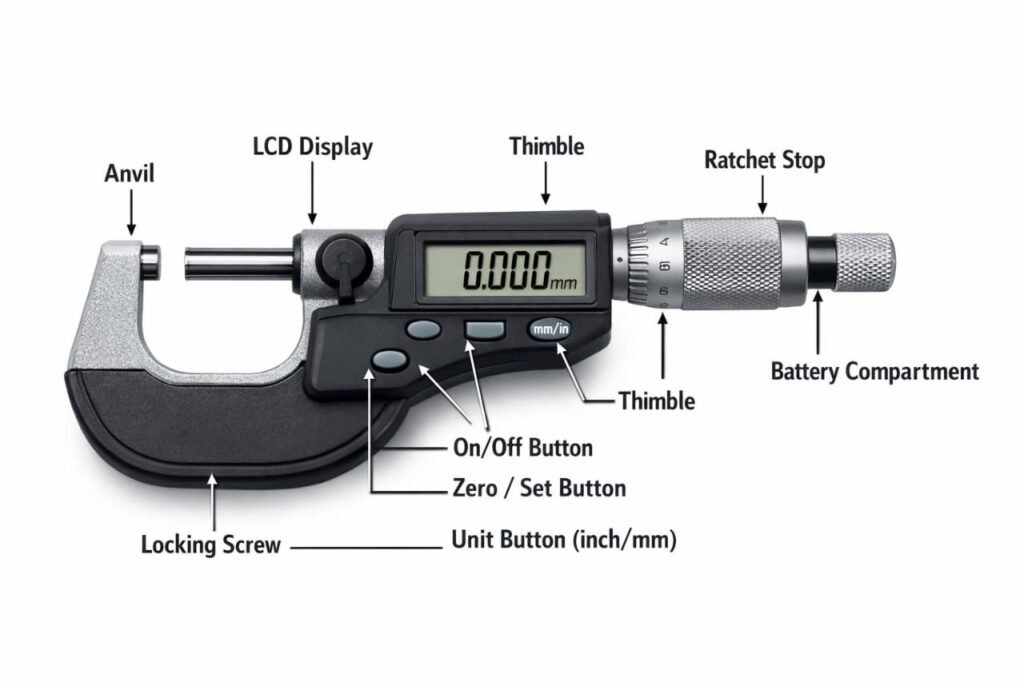
Just like any other precision instrument, the digital micrometer has some significant parts that make it easy to measure.
Frame
The frame is the main body that encloses the micrometer. The frame is the strongest part and holds the entire micrometer together.
Anvil
The anvil is the fixed part that is used to measure the object.
Spindle
The spindle is the moving part that is used to measure the object.
Thimble
The thimble is the rotating part that is used to rotate the spindle.
Ratchet Stop
The ratchet stop is the part that is used to ensure that the right pressure is applied when making the measurement.
Digital Display
One of the main advantages of the digital micrometer is that it has an LCD display that is used to display the reading.
Battery Compartment
The digital micrometer is powered by a battery because it has an LCD display.
Types of Digital Micrometers
It is important to note that there are various types of digital micrometers, and they are all used for specific purposes. The main types of digital micrometers are:
Outside Micrometer
This type of digital micrometer is used for the measurement of the outside diameter and thickness of objects such as rods, wires, and metal sheets.
Inside Micrometer
Inside digital micrometers are used for the measurement of the internal diameter of holes and pipes.
Depth Micrometer
This type of digital micrometer is used for the measurement of the depth of holes and slots.
Advantages of Digital Micrometers
There are many reasons why digital micrometers are favored in today’s workshops and industries.
High Accuracy
micrometers are known for their high accuracy, and this is what makes them the first choice in the field of engineering and manufacturing.
Easy to Read
Unlike analog micrometers, digital micrometers are easy to read as the numbers are displayed directly on the screen.
Reduced Human Error
As the numbers are displayed directly on the screen, the chances of human error are significantly reduced.
Unit Conversion
Digital micrometers are designed in such a way that users can easily switch between millimeters and inches with the press of a button.
Faster Measurements
Digital micrometers make it easier and more convenient for users to take measurements.
Both micrometers and vernier micrometers are precise instruments for measurement, and they are different in many ways.
Reading Method
micrometers show the measurement on a screen, whereas in vernier micrometers, the user has to read the measurement on the scale.
Ease of Use
micrometers are easy to use because they show the measurement instantly.
Accuracy
Both instruments are accurate in measurement, whereas micrometers are free from human error in measurement.
Technology
micrometers make use of technology with the help of electronic sensors, whereas vernier micrometers make use of only mechanical instruments for precise measurement.
Therefore, in today’s modern world, many industries prefer using digital micrometers for precise measurement.
Customer FAQ
1.what is the purpose of using digital micrometers?
micrometers can be used to measure the thickness, diameter, and gap with high accuracy.
2.what is the accuracy level of digital micrometers?
The accuracy level of digital micrometers is about 0.001mm.
3.are digital micrometers superior to mechanical micrometers?
Digital micrometers can be used with great convenience as there is no chance of human errors.
4.can digital micrometers be used to measure inches and millimeters?
Yes, digital micrometers can be used to measure inches and millimeters.