
Introduction to Vernier Caliper
Table of Contents
Vernier caliper is considered to be one of the most frequently used measuring devices in the field of engineering, manufacturing, and mechanical practices. It is a measuring instrument that is intended for precise measurements. Unlike a normal ruler, a vernier caliper is capable of measuring extremely small dimensions such as the thickness, diameter, and even the depth of objects.
Vernier caliper is frequently used by machinists, engineers, students, and even technicians due to the precise measurements that it offers. This tool is capable of measuring the inner dimensions, outer dimensions, as well as the depth of the object. Due to the convenience that it offers, the vernier caliper is considered to be a vital measuring tool.
What Is a Vernier Caliper?
History of the Vernier Caliper
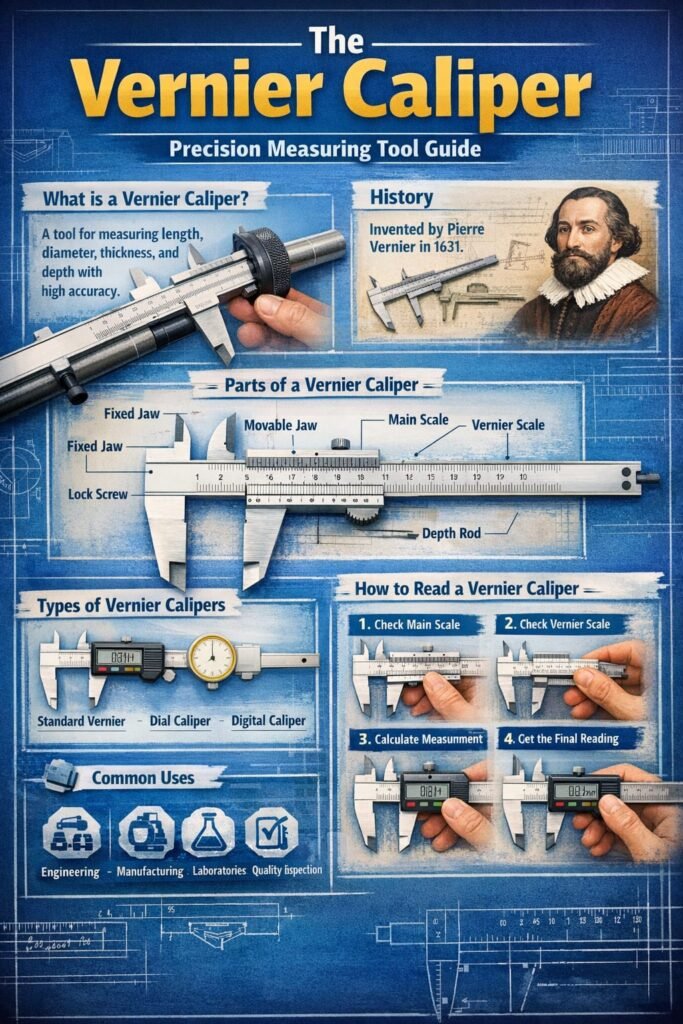
The Vernier Caliper was developed to provide a higher level of accuracy in measurement than was ever possible with earlier measuring devices. The basic idea of the Vernier Caliper was to use a Vernier scale, which was first proposed by the French mathematician Pierre Vernier in 1631. The Vernier scale was a small scale that was attached to a main scale. This enabled the Vernier Caliper to measure very small distances with a high level of accuracy. Because of its high accuracy, the Vernier Caliper has become one of the most important measuring devices.
Before the invention of the Vernier Caliper, people used basic measuring devices such as a ruler and a basic type of caliper. The basic **caliper** was not very accurate. The Vernier Caliper was a great invention because it enabled people to measure small distances with a high level of accuracy. The invention of the Vernier Caliper was very important because it enabled people to carry out various tasks with a high level of accuracy. The Vernier Caliper was very useful because it enabled people to carry out various tasks with a high level of accuracy.
Parts of a Vernier Caliper
Vernier calipers have several vital parts that enable them to perform their function.
Main parts of a vernier caliper:
Main Scale:
The main scale is the fixed scale that is usually marked in millimeters or inches. This scale gives the main reading.
Vernier Scale:
The vernier scale is a small scale that slides along the main scale. It is usually fixed to the moving jaw. It is used to measure the fractions of the smallest scale on the main scale.
Fixed Jaw:
The fixed jaw is the stationary jaw that is usually fixed in place. It is the reference point when measuring the size of the object.
Movable Jaw:
The movable jaw slides along the main scale. It is usually fixed in place to hold the object that is being measured.
Depth Rod:
The depth rod is the rod that comes out from the end of the vernier caliper. It is used to measure the depth of a hole.
Lock Screw:
The lock screw is the screw that locks the moving jaw in place to give a fixed reading.
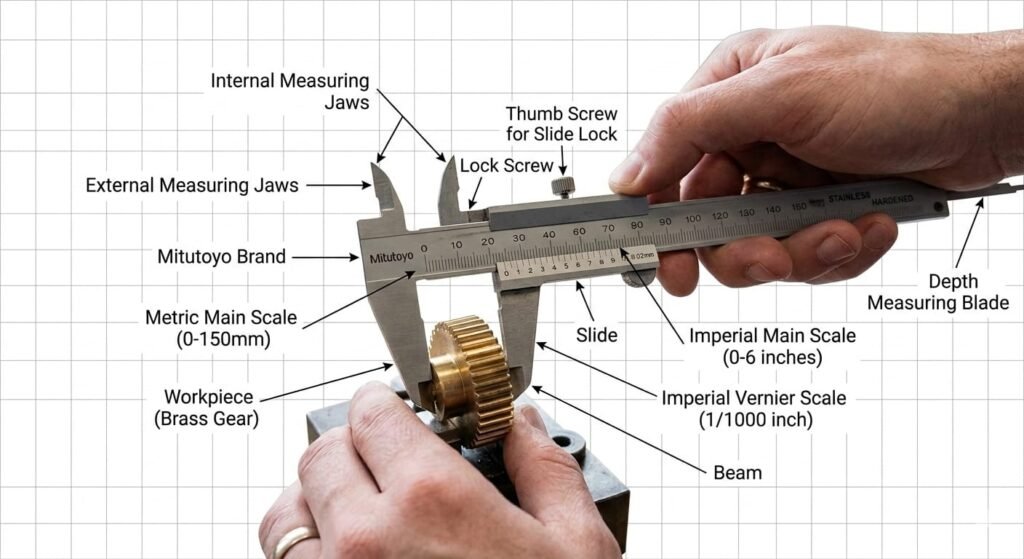
A Vernier caliper uses two scales, one of main scale divisions and another of Vernier scale divisions. The Vernier scale is fixed in such a way that it moves when the movable jaw of the Vernier caliper slides over the main scale. The Vernier caliper uses these two scales to take precise measurements.
When an object is placed in the Vernier caliper, one of its jaws is moved to firmly grasp the object. The measurement is obtained by looking at the Vernier scale in relation to the main scale.
As the Vernier scale is divided into smaller parts of the smallest division of the main scale, it is capable of measuring small distances.
Types of Vernier Calipers
There are various kinds of Vernier Calipers, each of which is suitable for different requirements.
Standard Vernier Caliper
This is the standard Vernier Caliper that uses the Vernier scale for the measurement.
Dial Caliper
A dial Vernier Caliper has a dial indicator that makes the reading clearer.
Digital Vernier Caliper
A digital Vernier Caliper uses an electronic device for the measurement, and the reading is very clear.
Each of the Vernier Calipers has its own benefits, but the common requirement of each is to give accurate measurements.
It may seem a bit hard to read a vernier caliper at first, but it can be mastered easily.
Step 1: Check the main scale
We need to check the main scale first and identify the number right before the zero point of the vernier scale.
Step 2: Check the vernier scale
We need to identify the vernier scale that lines up with a number on the main scale.
Step 3: Calculate the measurement
We need to multiply the vernier scale number with the least count and add it to the number on the main scale.
Step 4: Write the final reading
We have the accurate value for the measurement of the object using the vernier caliper.
This method can be used to measure objects using a vernier caliper with a lot of accuracy, unlike a ruler.
Customer FAQ
- What is the use of a vernier caliper?
A vernier caliper is used for the measurement of the internal diameter, external diameter, thickness, and depth of objects precisely.
- What is the least count of a vernier caliper?
The least count of a vernier caliper is usually 0.02 mm or 0.01 mm, depending on the design of the tool.
- Can a vernier caliper be used for the measurement of depth?
Yes, a vernier caliper has a depth rod that allows the measurement of the depth of holes and cavities.
- Where is a vernier caliper commonly used?
A vernier caliper is commonly used in the mechanical workshop, in the manufacturing industry, and in the engineering laboratory.
- Is a vernier caliper more accurate than a ruler?
Yes, a vernier caliper is much more accurate than a ruler because it can measure very small dimensions precisely.