
Table of Contents
Introduction to Digital Tools vs Manual Tools
The comparison of digital tools vs manual tools has gained importance in the present dynamic era. The individuals working in workshops or offices choose whether to adopt traditional tools or digital ones in their respective places. Though manual tools are conventional and easier to operate, digital tools can save time, improve accuracy, and help automate many activities. Thus, by comparing digital tools vs manual tools, you can make a more informed decision regarding the choice of your tool.
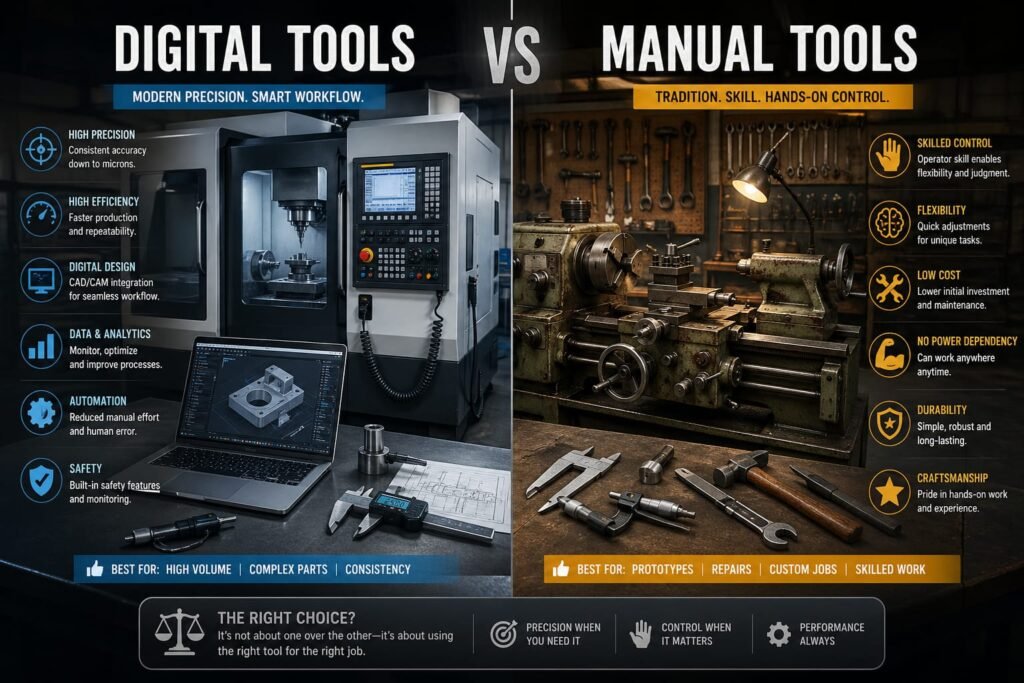
Manual tools are conventional tools that are run manually without the assistance of electricity, software, or any kind of technology. These tools completely depend upon manual labor. Examples of manual tools include hammers, spanners, screwdrivers, hand saws, and measuring tapes.
These kinds of tools have widespread use in workshops and construction sites. Using these tools is quite easy as well as these tools do not require any technical knowledge. But the main drawback of manual tools is that they are very labor-intensive.
What Are Digital Tools? (Modern Technology)
The digital tool is considered to be an advance type of tool which makes use of electronic or automated means to undertake activities. This includes tools such as CNC machine, digital caliper, laser measurement devices, and computerized tools such as designing programs.
In the comparison between digital tools and manual tools, the main advantages possessed by the former include higher level of precision, speed, and minimum possibility of errors.
Key Differences Between Digital Tools vs Manual Tools
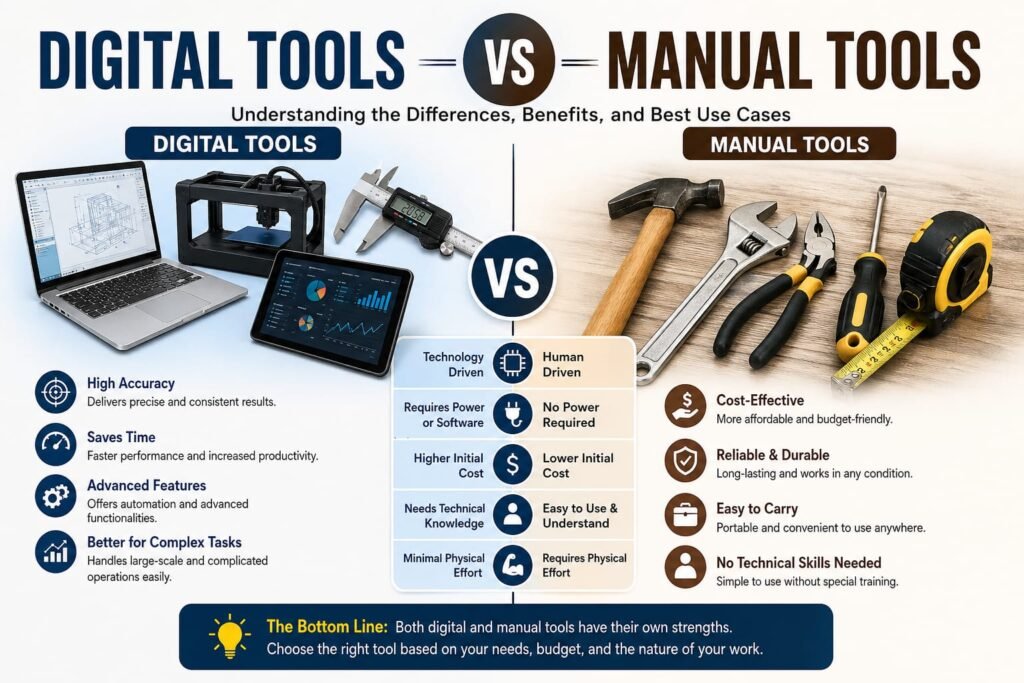
The key distinction between digital tools and manual tools is the mode of operation.
Manual tools use manual labor
Digital tools use technology
Manual tools take time but are straightforward
Digital tools are speedy and precise
Manual tools demand expertise and proficiency
Digital tools need technological knowledge
It can be observed from the above comparison that each tool fulfills a unique purpose based on circumstances.
The usage of manual tools is significant in numerous industries. The advantages of using manual tools include:
Can be used easily without requiring technical skills.
More economical than digital tools.
No requirement for power and software.
They can be portable and reliable when used at remote locations.
Need minimal maintenance.
In the debate between digital and manual tools, the latter fits better for small jobs.
Advantages of Digital Tools
Several benefits of digital tools include:
- High precision and accuracy
- Quicker completion of jobs
- Minimal errors caused by humans
- Complex task management
- Automation increases efficiency
In a comparison between digital tools and manual tools, digital tools emerge as the better alternative for massive industrial jobs requiring precise calculations.
Disadvantages of Manual Tools
However, despite their benefits, manual tools also face some challenges:
Take more time to complete
Have less precision than electronic tools
Cannot be used for complicated operations
Lack productivity
Dependent on user proficiency
Therefore, manual tools prove to be less effective in today’s industries.
Disadvantages of Digital Tools
But digital tools have their own set of problems too:
They are expensive initially
They need electrical energy to work
They require expertise in using them
They may be costly to maintain
Their dependency on software/systems
So digital tools versus manual tools, digital tools are strong but not always feasible in all cases.
Use Cases: When to Use Manual vs Digital Tools
Choosing between digital tools vs manual tools depends on the type of work:
Manual tools should be used where:
The job is easy and straightforward.
There is no power source available.
The budget is tight.
Portability is necessary.
Digital tools should be used where:
Precision is essential.
The job is repetitive and large.
Efficiency and speed matter.
Automation saves time.
Digital Tools vs Manual Tools: Cost Comparison
In the selection of either digital or manual methods of work, cost is a critical issue.
Manual methods of working have a low cost of purchasing and maintaining equipment
The digital method is more costly initially
The digital tool is economically efficient over a period of time
Manual methods are economically efficient when used by individuals
Therefore, the decision will depend on which one takes priority – economical or productivity.
Which One Is Better for Your Needs?
The solution to the question between digital instruments and traditional instruments is subjective and varies depending on individual preferences.
If working on simple tasks → traditional instruments will be enough
If you want professional results → digital instruments are preferable
If looking for affordable options → traditional instruments are perfect
If aiming for efficiency and accuracy → digital instruments are the way to go
A practical strategy is to combine both types of instruments.
Future Trends: Are Digital Tools Replacing Manual Tools?
The usage of digital tools is growing very fast because of technological advances like automation, AI, and intelligent tools. Manual tools are being replaced with digital tools in many sectors to increase efficiency.
But manual tools cannot become obsolete totally. There will still be uses for manual tools when they are required.
Thus, in the future of manual tools versus digital tools, there will be a co-existence but dominance of digital tools.
Conclusion
Comparison between Digital Tools and Manual Tools has revealed the significance of both tools in their respective domains. Manual Tools are easy to use, low cost, and dependable whereas digital tools provide efficiency and precision in their operations.
The most effective way is to analyze your requirement and select an appropriate tool accordingly rather than selecting any one of them.
Customer FAQ
Q1: What is the basic distinction between digital tools versus manual tools?
The basic distinction is that manual tools depend on human labor, whereas digital tools depend on technology.
Q2: Are digital tools always superior to manual tools?
Not necessarily. Digital tools are better in terms of accuracy and efficiency, whereas manual tools are more realistic for simple work.
Q3: Which tools are more economical?
Manual tools require less initial investment, but digital tools may be cheaper in the long run because of their greater efficiency.
Q4: Is it possible to replace manual tools entirely?
Absolutely not. Manual tools have remained relevant in certain circumstances where digital tools cannot be utilized effectively.
Q5: Should I make use of both digital and manual tools?
Surely, the usage of both types of tools provides versatility and adaptability.