
Table of Contents
A hydraulic press is one of the most important equipment that one may use in a workshop or industry. This is a device that applies huge force using minimal efforts from the user. The hydraulic press can help you bend, press, form, straighten, or even assemble metal products.
In layman’s terms, a hydraulic press is an equipment that helps transfer the pressure using fluids. Therefore, it is the most effective when it comes to applying heavy-duty force where regular hand tools cannot perform. For instance, it is used in automobile workshops and manufacturing factories among other places. The hydraulic press is highly reliable in carrying out tough pressing jobs with precision and control.
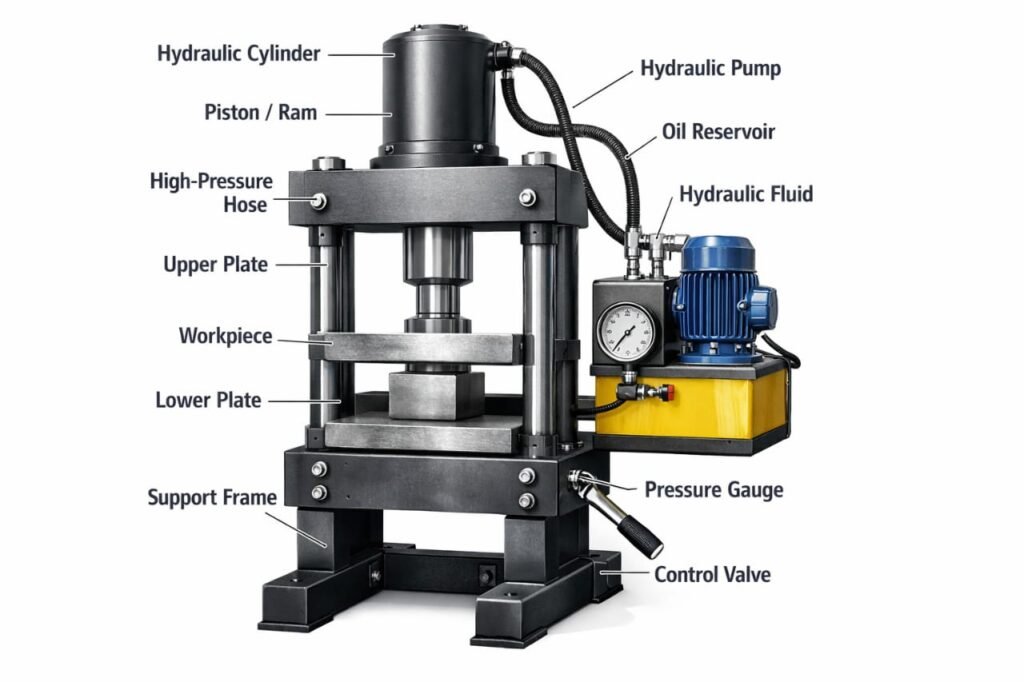
How a Hydraulic Press Works
The underlying principle of operation for the hydraulic press is the Pascal Law. Based on the Pascal Law, any force exerted to any enclosed fluid is transmitted equally in all directions, hence leading to production of high pressure. Consequently, whenever a small force is exerted to a smaller piston, a big force is produced from the bigger one.
Below are the steps followed in the operation of a hydraulic press machine:
- The pump or handle presses hydraulic oil.
- The oil flows in the machine producing pressure.
- The pressure forces a piston or ram downwards.
- The ram exerts a powerful force on the workpiece.
The above process enables the hydraulic press machine to carry out functions such as bending, stamping, straightening, and forming of metal parts. The greatest benefit of the hydraulic press machine is the fact that an individual can apply high or low pressures as desired.
There are different forms of hydraulic press tools, and depending on what you require from the tool, you may select any one of the following tools:
- Hand Operated Hydraulic Press
Hand-operated hydraulic presses use either a lever or a hand pump mechanism. These tools are most often found in workshop environments and are suitable for lighter pressing duties.
- Bench Hydraulic Press
These presses are smaller in size and are mounted on a workbench. They can be used for lighter duties such as bearing press out, bending, and assembling.
- Floor Hydraulic Press
This form of a hydraulic press is bigger in size compared to a bench hydraulic press and is best suited for industries that require greater pressing duties.
- Hydraulic Shop Press
Hydraulic shop presses are used extensively in the automotive and mechanics shop for jobs like pressing, bending, bearing press-out, and metal-forming tasks.
- Hydraulic Punch Press
These machines are specifically designed to punch holes into sheets or metal plates. They can be found extensively in manufacturing plants.
- C-Frame Hydraulic Press
In a C-frame hydraulic press, access is provided from three sides. This machine is commonly employed in assembling and maintenance procedures.
Different types of hydraulic presses have different advantages, depending upon what kind of job is being done.
Main Components of a Hydraulic Press Tool
There are various components of a hydraulic press that help it in generating force and pushing the ram.
- Frame
Frame is the body of the press. All the components of the press are attached to the frame. The frame provides structural strength to the system.
- Hydraulic Cylinder
Cylinder is the component that acts as a converter of fluid pressure to mechanical force. Inside the cylinder, there is a piston that moves due to the action of pressure inside the cylinder.
- Piston or Ram
Piston/ram is the movable component that exerts pressure on the material under processing.
- Hydraulic Pump
The pump is the device that applies pressure on the hydraulic fluid. Depending upon the size of the machine, pumps can either be manual or electrically operated.
- Hydraulic fluid
Hydraulic fluid serves as a medium of carrying pressure in the hydraulic press. It is an important component of the press for transmitting pressure efficiently and effectively.
- Pressure gauge
Pressure gauge indicates the level of pressure applied in the process. The gauge allows controlling the pressure.
- Control valves
Control valves control the flow of the hydraulic fluid within the system.
- Work table
Work table is a part of the press, which serves as a surface for placing the material during pressing.
All parts perform their roles in making the hydraulic press efficient and effective.
Applications of Hydraulic Press Tools
The hydraulic press machine is widely used due to its power and versatility. Hydraulic presses are capable of performing different operations in various industries.
Use in the Automotive Industry
Hydraulic presses are employed in bearing pressing, part straightening, gear pulling, and assembly.
Use in Manufacturing Industries
Hydraulic presses are used for shaping and molding, compression, and forming of metal and plastic components in manufacturing.
Use in Metal Fabrications
Hydraulic press machines are employed by fabricators in bending, punching, stamping, and forming sheet metals.
Use in Maintenance/Repair
A hydraulic press is applied in shaft correction, removal of broken parts, and alignment in repair shops.
Plastics and Rubber Manufacturing
The hydraulic press is used in manufacturing molds and compaction of plastics and rubbers as well.
Recycling Industry
The hydraulic press facilitates the compaction of scrap metals, plastics, and paper, making the process easier.
These various applications make the hydraulic press one of the most useful devices in modern industries.
Advantages of Hydraulic Press Tools
There are various reasons why a hydraulic press should be favored in workshops or factories.
Low Input Force, High Output Force
This means that the operator requires less effort when operating the machine.
Accuracy
Pressure can be regulated to suit the job, hence reducing the risk of damaging the material being processed.
Diverse Applications
It can be used for pressing, molding, straightening, punching, forming, and assembly.
Smooth Movement
The operation of this machine involves a stable movement.
Heavy Work Capacity
Some heavy tasks can only be accomplished using a hydraulic press.
In the Long Run, It Is Economical
Even though initially more money is required to acquire one, its efficiency pays off in the long run.
Comparatively Safer Machine
Its use in the right way guarantees safe application of pressure.
This list explains why a hydraulic press is such an important machine to have.
While both hydraulic and mechanical presses apply pressure through their actions, they operate in different ways, and each can be more useful than the other in different situations.
Hydraulic Press
The hydraulic press operates through fluid pressure, and the output from this type of press comes out smoothly and controllably. It is very appropriate for operations where the amount of pressure applied needs to vary.
Mechanical Press
On the other hand, the mechanical press applies force using a flywheel, a crank mechanism, or a motor. It is much quicker than the hydraulic press, making it better for repeated actions such as stamping.
Primary Difference
The primary difference lies in the aspect of speed and control. Hydraulic press offers better control over the applied force, whereas the mechanical press provides quick cycles.
Which Press Is Better?
It depends on the purpose. If high precision, variable pressure, and powerful pressing are required, then the hydraulic press is definitely the right option.
Buying Guide for Hydraulic Press Tool
When purchasing a hydraulic press, one needs to consider what is required from the machine in terms of its capabilities. Such consideration will ensure saving of both time and resources.
- Verify the Capacity of the Press
The most important thing when selecting a machine is its capacity. Workshop operations will be sufficient with less powerful press machines, while industrial operations will require high-capacity presses.
- Consider the Type of Operation Required
Depending on whether you intend to remove bearings, bend materials, punch holes, or assemble objects, you should consider the type of press needed.
- Take note of its build quality
Its sturdy frame, solid cylinder, and other high-quality parts are vital for long-lasting use.
- Assess the size
Ensure that the hydraulic press is of an ideal size for your workspace.
- Examine ease of use
The best hydraulic press is one that is easy to operate and maintain.
- Evaluate safety features
Various safety features like pressure gauge, safety locks, stable frame, and others ensure safe operation of the machine.
- Maintenance needs
Select a hydraulic press that is easy to maintain and service throughout its life.
- Compare cost and value
Do not just consider the price; even a little expensive but better machine will save you more costs.
By following the above considerations, you can find a hydraulic press that will suit your operations very well.
Conclusion
Hydraulic presses are useful machines applied across different sectors due to their capabilities. They are machines that work by applying force through the use of hydraulic fluid pressure. This is an essential machine when performing different tasks in fields such as automotive repairs, metal works, and production.
Knowledge about the functioning of a hydraulic press, its components, and other aspects will assist in selecting a hydraulic press that suits your requirements. Be it a beginner, technician, or an individual operating a business, choosing the right hydraulic press is crucial.
Customer FAQ
- For what purpose is a hydraulic press used?
A hydraulic press is used to press, bend, shape, punch, straighten, and assemble various materials.
- How strong is the pressure of a hydraulic press?
The strength varies from one hydraulic press to another. There are some that do light jobs while others that have very strong forces.
- Are hydraulic presses easy to use?
Hydraulic presses are fairly easy to use provided that the person handling them understands how to use them.
- What is the primary advantage of a hydraulic press?
The primary advantage is that it can generate high force using minimal effort.
- In which industries do hydraulic presses have applications?
They find application in the automotive industry, manufacturing processes, metal working, maintenance operations, recycling operations, and plastic molding.
- How do I select the appropriate hydraulic press?
It should be selected according to its pressing capacity, nature of work, size, construction, safety features, and ease of maintenance.